
Indoor drains get attention because they are used every day. The drainage outside gets none at all until the day water is standing where it should not be, or a gully is overflowing across a path, or something smells in a way that only outside drains manage.
Tami Plumbing carries out drain unblocking in Beeston, and external drainage is worth a small amount of deliberate attention twice a year, because almost everything that goes wrong out there builds slowly and gives plenty of warning.
What blocks an outside drain
Outside drains block with leaves, silt or root disturbance, and the three behave differently enough that identifying which you have matters.
Leaves are seasonal and predictable. They collect in gullies, mat together and stop water passing, and they do it in the same few weeks every autumn. This is the easiest drainage problem to prevent and the most commonly ignored.
Silt is gradual. Fine material washes in over years and settles wherever the flow slows, reducing the effective size of the pipe until a heavy downpour exceeds what is left. It gives no warning until the day it does.
Roots are the serious one. Roots do not pass through sound pipework: they enter through a defect, a cracked section or a displaced joint, which means a root problem is always also a structural problem. Clearing the roots without addressing the pipe guarantees they return.
- Leaves: seasonal, predictable and preventable.
- Silt: gradual, quiet, then suddenly a problem in heavy rain.
- Roots: always indicate a defect they entered through.
- A blockage that returns yearly has a cause, not bad luck.
Checking your own drainage, safely
There is a useful amount of inspection any homeowner can do without any equipment. Look at each gully around the property: the water should be visible and the grating clear. A gully full to the top, or one where you cannot see the water at all, is telling you something.
Run a tap or a hose and watch. Water should disappear promptly rather than pooling and slowly draining. Do the same after heavy rain and see whether anything stands where it should not.
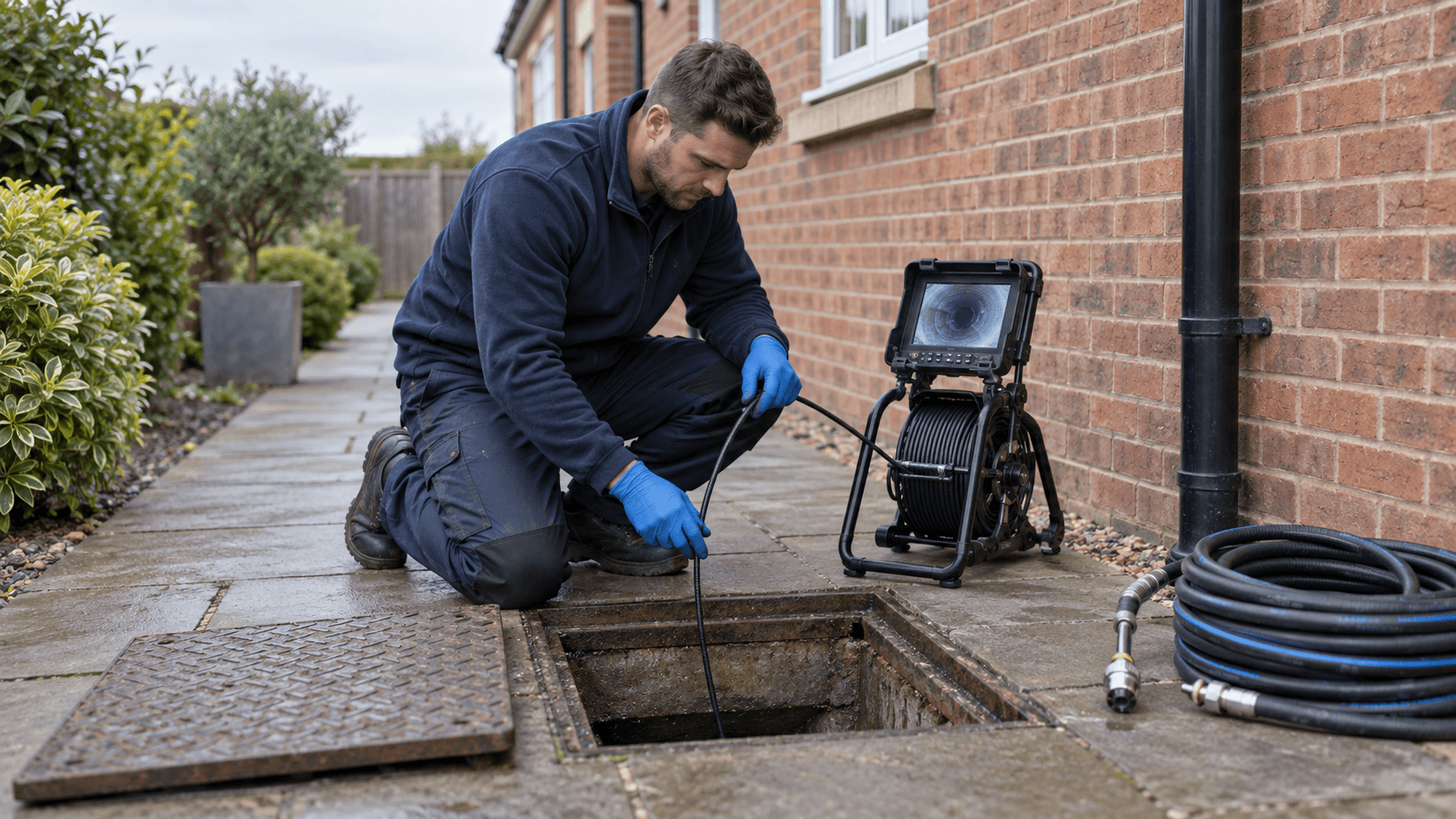
Inspection chamber covers can often be lifted to look, though heavy or corroded ones are best left alone rather than damaged. If you do look, the useful observation is simply whether water is flowing through the channel or standing in it. Standing water in a chamber means a restriction downstream of it.
Do not put your hands into standing drainage water, and replace covers properly. The point of the inspection is information, not intervention.
The autumn routine
Ten minutes twice a year prevents most external blockages. Before autumn, clear gullies of debris and check that gratings are intact and sitting properly. After the leaves have fallen, do it again.
Clear gutters at the same time, because a blocked gutter overflows into places it was never meant to and delivers a season's worth of debris straight into whatever is below.
Where drainage from a gully is regularly overwhelmed, look at what is feeding it. A downpipe discharging into a gully that also takes a kitchen waste is doing two jobs, and in a downpour the two compete.
Repeated blockages in the same place are worth investigating properly rather than clearing annually. Tami Plumbing uses CCTV cameras and high-pressure jetting to find and fix the problem, and the camera is what distinguishes a routine build-up from a defect, a sag or root intrusion.
- Clear gullies before and after the leaves fall.
- Clear gutters at the same time; they feed the same drains.
- Check what discharges into each gully and whether it is overloaded.
- Investigate a blockage that returns yearly rather than clearing it again.
When it is not your drain
Not all drainage belongs to the property. Some sections are shared or are the responsibility of the water company rather than the homeowner, and it is worth knowing roughly where that boundary sits before assuming a bill is yours.
The signal that usually points that way is more than one property being affected at the same time. If a neighbour is having the same trouble in the same week, the shared section is the more likely culprit.
Inside the property, the diagnostic questions are the same as ever: where the water is backing up, whether more than one fixture is affected, and whether the problem is inside the property or in the external drainage.
Where the issue does turn out to be internal, the follow-on routes are clear. A blocked toilet that has become urgent may need emergency plumbing, and damp patches or smells after a drainage issue may need leak detection to establish whether anything has escaped where it should not.
Related pages
Questions customers ask
Why does my outside drain overflow every autumn?
Leaves. They collect in the gully, mat together and stop water passing, and they do it in the same few weeks each year. Clearing gullies and gutters before and after the leaves fall prevents most of it.
Can I lift my own inspection chamber cover?
Often yes, if it is not heavy or corroded. Look for whether water is flowing through the channel or standing in it, because standing water means a restriction downstream. Do not reach into standing water, and replace the cover properly.
What does it mean if roots are in my drain?
That there is a defect they entered through, such as a crack or a displaced joint. Roots do not penetrate sound pipework. Clearing them without dealing with the defect means they will return, which is why a camera survey is worth doing.
Clear gullies and gutters twice a year, watch how water disappears after rain, and treat a blockage that returns annually as a question rather than a chore.
Tami Plumbing clears external drains in Beeston and uses a camera when the same run keeps blocking. The contact page is the place to describe what is happening outside.