
Power flushing is sold more often than it is needed, and skipped more often than it should be. Both mistakes come from the same place: treating it as a product rather than as the answer to a specific diagnosis.
Tami Plumbing carries out power flushing in Nottingham, and the useful part of the service is the assessment that happens first. A flush matched to the condition of the system is genuinely valuable; a flush sold on symptoms alone is a gamble.
The symptoms that actually indicate sludge
Sludge is iron oxide produced by corrosion inside a steel heating system, and it settles wherever the flow is slowest. That is why its signature is so specific.
Cold radiator bottoms with warm tops are the classic sign: water is passing over settled deposits rather than through them. Noisy pipework and a boiler that struggles to run smoothly point the same way, because restricted flow makes the appliance work against itself. Slow warm-up across the whole house is the third.
Black water when a radiator is bled or drained is the most direct evidence there is. Clear water suggests the problem is somewhere else entirely.
What these symptoms have in common is that they are about circulation. A single cold radiator while every other one is fine is much more likely to be a valve or balancing issue, and flushing an entire system to fix one closed lockshield is an expensive way to solve a free problem.
- Cold bottoms with warm tops on several radiators.
- Noisy pipework and a boiler that will not run smoothly.
- Slow heat-up times across the whole house.
- Black water at a bleed valve or drain point.
What the assessment should check first
A proper assessment looks at the boiler, radiator condition, valves, pump performance and whether any part of the system is too weak or corroded for aggressive cleaning. That last clause is the important one and it is the one most often skipped.
Power flushing works by moving water at high velocity through pipework and radiators, often reversing the direction of flow. On a sound system that lifts and removes deposits. On a system with thin, heavily corroded radiators or fragile joints, the same forces can find every weak point at once.
That is not an argument against flushing. It is an argument for looking first, and for being told honestly when a system would be better served by replacing the worst radiators or by a gentler chemical clean.
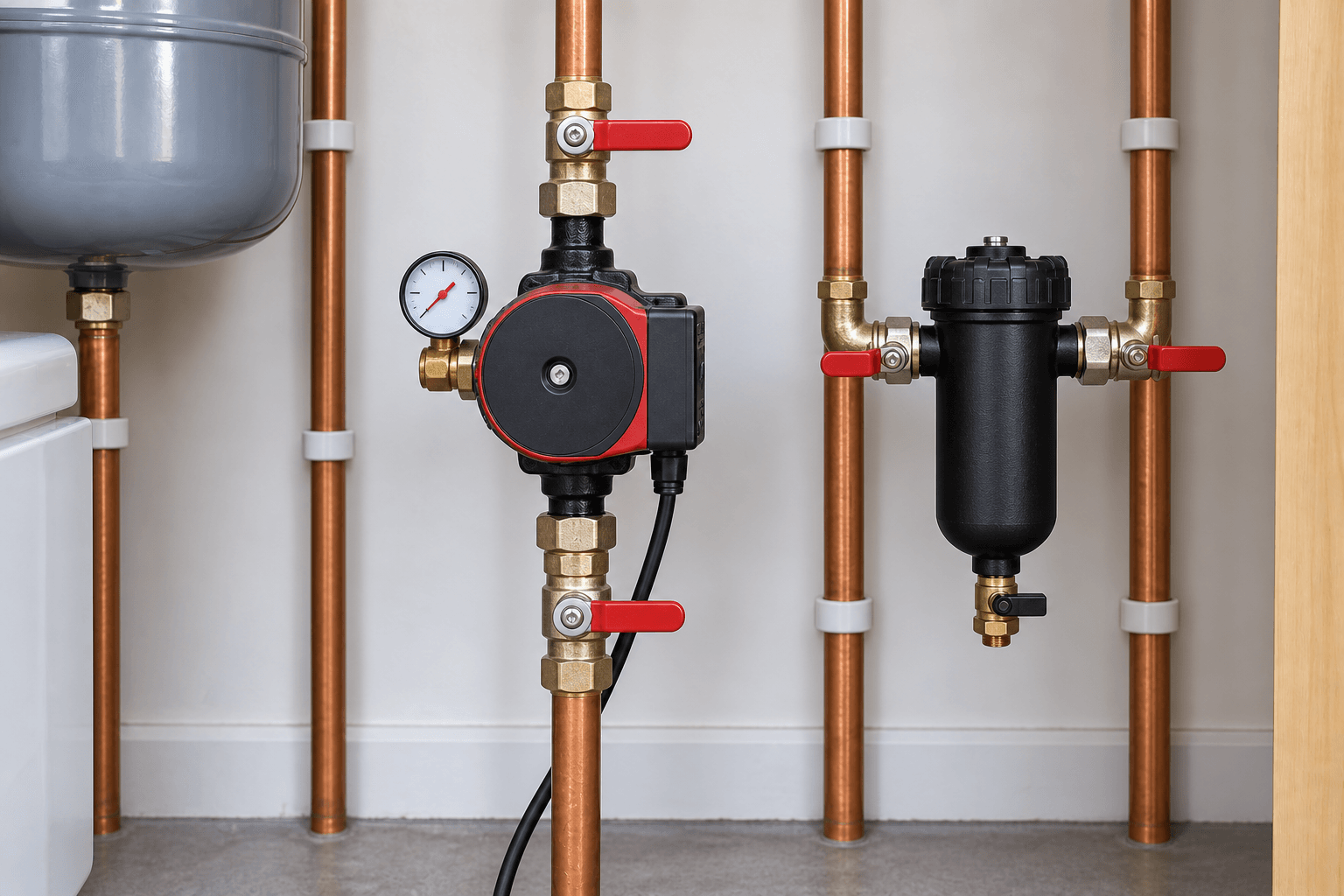
Pump performance belongs in the assessment too. A pump that has weakened will produce circulation symptoms that look exactly like sludge, and cleaning a system will not fix a pump that can no longer push water round it.
What has to happen afterwards
A flush on its own is a temporary state. The corrosion that produced the sludge continues the moment the system is refilled unless something changes.
Inhibitor goes back in at the correct concentration. This is not optional and it is not expensive; it is what stops the process starting over. A system flushed and refilled without inhibitor will be producing new deposits within months.
A magnetic filter is the other half. It catches iron oxide as it forms and gives whoever services the system somewhere to remove it from each year. On a system that has just needed flushing, a filter is close to essential.
And whatever was letting oxygen into the system needs finding. Repeated pressure loss followed by repeated topping up is the most common cause: every refill brings fresh oxygenated water, which is exactly what the corrosion needs to continue.
- Inhibitor added at the correct concentration after cleaning.
- A magnetic filter fitted, then cleaned at every service.
- Any pressure loss traced and repaired rather than topped up.
- The system rebalanced so the improvement is even across the house.
Where it fits with everything else
Power flushing often sits alongside central heating improvements, boiler repair or a planned boiler installation where the customer wants the new appliance protected from dirty water.
That last case is the strongest argument for it. A new boiler has narrow passages and far less tolerance for debris than the appliance it replaces, and a manufacturer is entitled to ask about system water quality if a heat exchanger fails early. Cleaning at the point of replacement is much cheaper than the argument afterwards.
Where a flush is not the answer, the honest alternatives are worth naming: balancing a system that has never been balanced, replacing individual radiators that are beyond saving, dealing with a failing pump, or repairing the leak that has been quietly bringing oxygen in.
Tami Plumbing assesses the system before recommending the clean, which is the only way to tell which of those you actually have.
Related pages
Questions customers ask
How do I know if I need a power flush?
Look for cold bottoms on several radiators, noisy pipework, slow warm-up and black water when bleeding. One cold radiator while others are fine is more likely a valve or balancing issue, which is a much cheaper problem to solve.
Can a power flush damage my heating system?
It can, on a system with heavily corroded radiators or fragile joints, which is why the assessment should check whether any part is too weak for aggressive cleaning. A responsible answer sometimes is that a gentler approach or replacing the worst radiators is the better route.
What has to be done after a flush?
Inhibitor at the correct concentration, ideally a magnetic filter, and any pressure loss traced and repaired. Without those, the corrosion that produced the sludge simply starts again from the day the system is refilled.
Diagnose before flushing, check whether the system can take it, then protect the result with inhibitor and a filter. A flush without those three steps is a job that will need repeating.
Tami Plumbing assesses heating systems in Nottingham before recommending a clean, and will say when a flush is not the right answer. The contact page is the place to start.