A boiler repair either happens on the first visit or it becomes two visits and a wait for a part. What decides which is almost never the difficulty of the fault. It is whether the engineer knew what he was coming to before he left.
Tami Plumbing carries out boiler repair in Nottingham, and there are five things worth sending before the appointment. Together they turn a diagnostic call-out into a repair call-out.
The five things
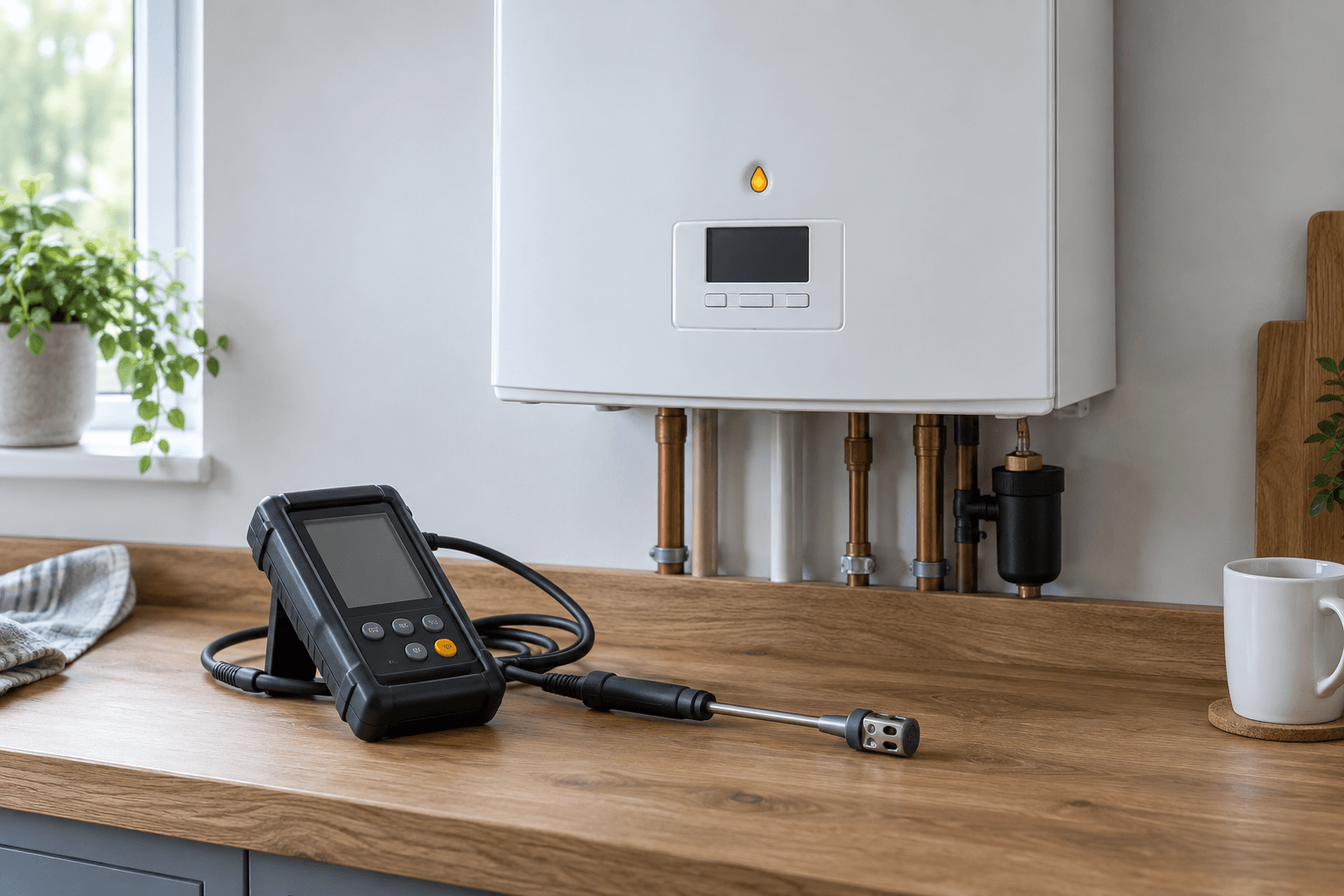
Send the boiler make and model, a photo of the fault code, the pressure gauge and any leak, plus whether heating or hot water is affected. That short list covers most of what determines which parts are worth carrying.
The make and model is on a badge or sticker, usually behind the front flap. Photograph it rather than typing it, because model numbers have suffixes that matter and are easy to mistype.
The fault code should be photographed too. Codes are easy to misremember, several look alike across a range, and the photograph captures the state of the display, which sometimes says more than the code itself.
The pressure gauge tells the engineer whether he is looking at a sealed-system problem before he arrives, and a photo of any visible leak tells him whether to bring what he would need for it.
- Boiler make and model, photographed from the badge.
- A photograph of the fault code or display message.
- A photograph of the pressure gauge, taken when the system is cold.
- A photograph of any visible leak or staining.
- Whether heating, hot water or both are affected.
Why heating-or-hot-water is such a useful question
It sounds like a trivial detail and it is one of the most diagnostic things you can say. A boiler that provides heating but no hot water is behaving very differently from one that does neither, and the two point at different parts of the appliance and the system.
Adding the pattern makes it better still. Does it work for a while and then stop? Does it fail only when both heating and hot water are called for? Is it worse in cold weather? Has it started since other work was done in the house?
Boiler repair starts with the symptoms: fault code, pressure loss, leaks, ignition failure, no heating, no hot water, unusual noise or radiators that never get fully hot. Those clues decide whether the fault is inside the boiler or somewhere else in the heating system, and the more of them you can supply, the narrower the search.
Intermittent faults especially deserve description. Something that fails once a day and clears itself is a very different problem from something that has stopped entirely, and it is often the harder one to catch in a single visit.
Resets, pressure and the two things not to do
There are two common habits worth breaking. The first is repeated resetting. A lockout is a safety device objecting to something, and resetting it repeatedly asks it to keep permitting a condition it has already refused. Once, to confirm it was not a one-off, is reasonable. Six times is asking for a bigger repair.
The second is topping the pressure up on a schedule. A sealed system should hold its pressure for months. If you are refilling regularly, water is leaving somewhere, and every refill brings in fresh oxygenated water that accelerates corrosion inside the radiators and the boiler.
Both habits mask the fault. Worse, they mask it in a way that removes the evidence: an engineer who arrives after six resets and a fresh top-up is looking at a system that has been reset to hide exactly what he needs to see.
If you have done either, say so. It is genuinely useful information rather than something to be embarrassed about.
- Reset once to test, not repeatedly.
- Note how often you have topped up the pressure, and when.
- Say what you have already tried; it narrows the diagnosis.
- Do not clean up the evidence of a leak before it is seen.
When the boiler is not the problem
Some boiler faults are simple. Others are caused by poor circulation, dirty system water or controls that need attention, and those will keep returning however many parts are fitted to the appliance.
The signals are usually visible in the rest of the house. Radiators that never get fully hot, cold patches at the bottom of several radiators, noisy pipework or a boiler that short-cycles all point outwards from the appliance into the system.
Where that is the case, the honest next step may involve boiler installation, central heating work or power flushing rather than another repair, and it is better to hear that clearly than to pay for a third visit to the same fault.
It is worth mentioning radiator behaviour when you report a boiler fault even though the two feel unrelated. Very often it is the piece of information that explains the whole pattern.
Related pages
Questions customers ask
How many times can I reset my boiler?
Once to confirm the lockout was not a one-off, maybe twice. Repeated resetting asks a safety device to keep allowing something it has already objected to, and it can turn a small fault into a much more expensive one.
What should I photograph before booking a repair?
The make and model badge, the fault code on the display, the pressure gauge when the system is cold, and any visible leak or staining. Those four photographs plus whether heating or hot water is affected cover most of what decides which parts to carry.
Why does my boiler keep breaking down?
Repeat failures usually point outside the appliance: poor circulation, dirty system water or controls that need attention. Fixing the cause is generally cheaper than continuing to repair the effect, so it is worth asking whether the system rather than the boiler is the real fault.
Four photographs and one sentence about whether it is heating, hot water or both. That is the whole of the preparation, and it is the difference between a repair visit and a diagnostic one.
Tami Plumbing carries out boiler repair across Nottingham and would rather arrive knowing what it is looking at. The contact page is the place to send the details.