
A hot water cylinder is easy to ignore until the day it is not. It sits in a cupboard doing its job for years, and when it starts to fail the symptoms are vague enough that people put up with them for months: hot water that runs out sooner than it used to, or takes longer to come back, or never quite feels hot.
Tami Plumbing handles hot water cylinder work in Nottingham, and the first job is always to work out which problem you actually have, because repair, replacement and upgrading to an unvented system are three quite different conversations.
Reading the symptom
A cylinder that leaks needs attention immediately, and it is the one symptom that is never worth living with. Water around the base, staining on the floor of the cupboard or damp in the room below all belong in that category.
A cylinder that runs cold too quickly is usually about capacity or heat loss rather than failure. It may genuinely be too small for how the household now lives, or it may be losing heat through poor insulation or through pipework that is siphoning hot water away.
A cylinder that heats slowly points at how it is being heated: a coil that is no longer transferring heat well, a failed immersion element, a stuck valve, or a control that is not calling for hot water when you think it is.
Poor pressure is a different problem again, and it belongs to the type of system rather than the condition of the cylinder. A traditional vented cylinder fed from a tank in the loft delivers pressure based on the height of that tank, which is why the shower upstairs is often disappointing.
- Any leak: deal with it now, not later.
- Runs cold quickly: capacity, insulation or pipework losses.
- Heats slowly: coil, immersion, valve or controls.
- Poor pressure: usually the system type rather than the cylinder.
What an unvented upgrade actually involves
An unvented cylinder is fed directly from the mains, so it delivers hot water at mains pressure. That is why the upgrade is popular: balanced pressure at every outlet, no loft tank, and showers that work without a pump.
It is also a more involved installation than swapping like for like. Because the cylinder is under pressure, it carries safety devices, and those devices need somewhere to discharge safely. The discharge route is the single most common reason an upgrade is more complicated than expected, because it has to terminate somewhere safe and visible.
The mains supply has to be capable too. An unvented cylinder cannot deliver more flow than the incoming supply provides, so the mains flow rate should be measured rather than assumed. This is the same measurement that decides whether a combi would work, and it is worth having either way.
Unvented work requires the appropriate qualification, and Tami Plumbing is G3 qualified for unvented cylinders. It is entirely reasonable to ask about that before work is agreed, because it is a legal and safety requirement rather than a preference.
What the quote should specify
Cylinder work depends on the cylinder type, cupboard space, water pressure, controls, discharge route and whether the job is a repair, replacement or upgrade from a vented system. A quote should address all of those rather than naming a cylinder and a price.
Size deserves a proper conversation. A cylinder that is too small produces the exact complaint that prompted the job, and one that is too large heats water nobody uses. The right size follows from how many people, how many bathrooms and when demand actually peaks.
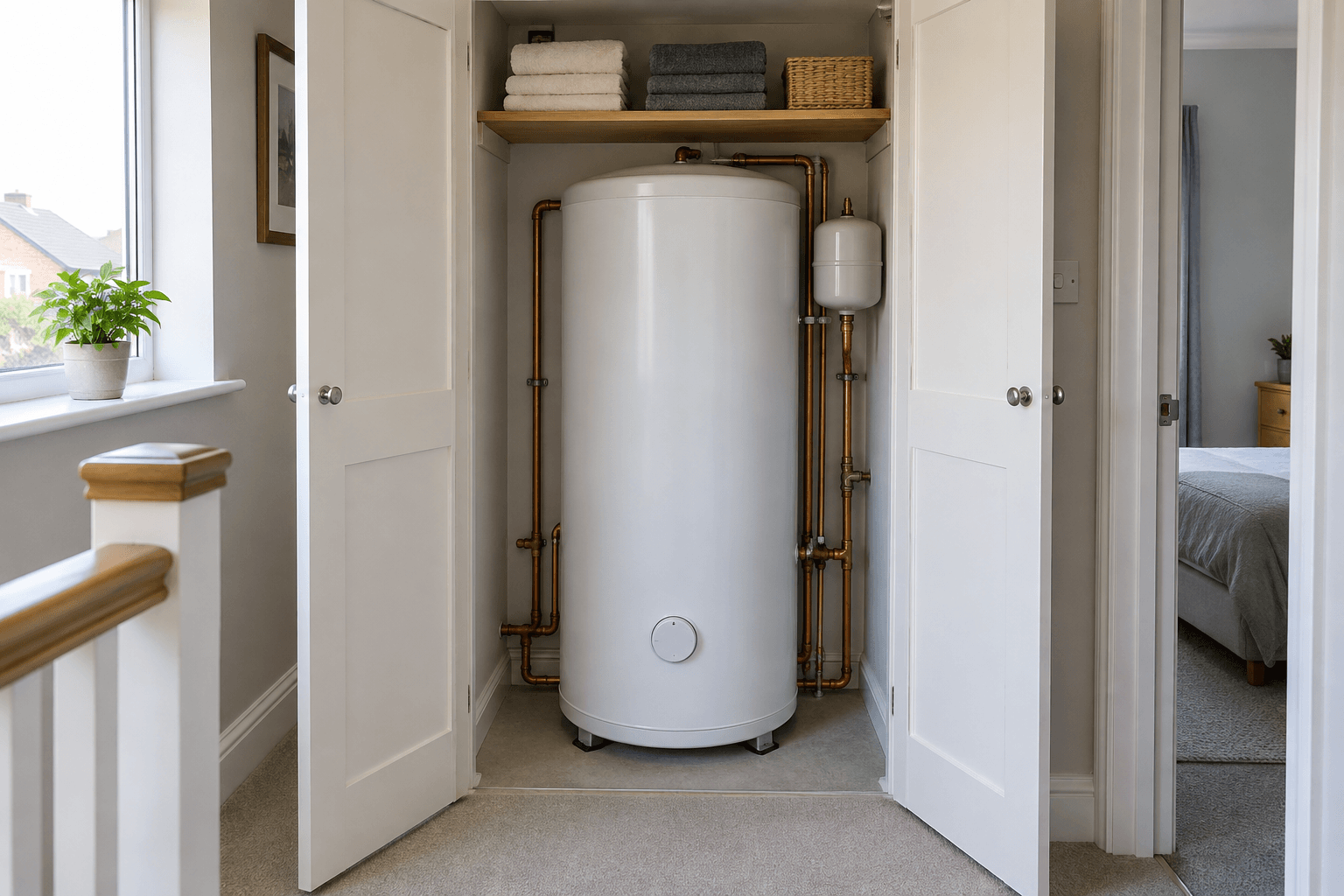
Space is the practical constraint. Cylinders are not all the same footprint, and an upgrade may need more room than the old one occupied, particularly once the associated components are allowed for.
The quote should explain the cylinder size, access, controls, pipework changes and the testing route. Access matters more than people expect: getting a cylinder into a first-floor airing cupboard is sometimes the hardest part of the whole job.
- Cylinder size justified by household demand, not by what was there before.
- Cupboard space and access confirmed before ordering.
- Discharge route identified and agreed for any unvented installation.
- Controls and pipework changes itemised rather than assumed.
When the cylinder is part of a bigger change
Hot water demand often changes during a bathroom renovation or a radiator upgrade, and those are exactly the moments to reconsider the cylinder rather than to work around it.
Adding a second bathroom, or replacing a bath with a large shower, changes the peak demand the cylinder has to meet. Doing the cylinder work at the same time avoids a second disruptive job a year later, and it means the pipework can be planned once.
The useful related routes are bathroom fitting, central heating and taps and fixtures, because a hot water complaint often turns out to involve all three: the cylinder, how it is heated, and what is being asked of it at the outlets.
A cylinder that leaks, runs cold too quickly, heats slowly or gives poor pressure needs a clear diagnosis before replacement is priced, which is the honest order: find out which of the four you have, then decide what the job is.
Related pages
Questions customers ask
What is the difference between a vented and an unvented cylinder?
A vented cylinder is fed from a tank, usually in the loft, so pressure depends on the height of that tank. An unvented cylinder is fed from the mains and delivers hot water at mains pressure, which is why showers usually improve, but it needs a safe discharge route and the right qualification to install.
Do I need a qualified engineer for unvented cylinder work?
Yes. Unvented work requires the appropriate qualification, and Tami Plumbing is G3 qualified for unvented cylinders. It is a safety requirement rather than a preference, so it is reasonable to ask before work is agreed.
Why does my hot water run out so quickly?
Usually capacity or heat loss rather than a fault: the cylinder may be too small for how the household now uses hot water, poorly insulated, or losing heat through pipework. Slow reheating points instead at the coil, immersion element, a valve or the controls.
Work out whether you have a leak, a capacity problem, a heating problem or a pressure problem. Those four point at four different jobs, and only one of them is a new cylinder.
Tami Plumbing handles hot water cylinder repair, replacement and unvented upgrades across Nottingham, G3 qualified for unvented work. The contact page is the place to describe the symptom.